
The Snow and Ice Control Program, approved by the Board of County Commissioners, guides how we prepare for storms, monitor conditions, and manage operations. We clear snow and ice from county roads as quickly and safely as possible. During heavy snow, cold temperatures, or high winds, the process may take longer, but our crews work continuously to keep roads safe.
Snow & Ice Control Program
Service Standards:
- Snow plowing operations begin when snow begins to accumulate on the roadways.
- Paved routes are plowed using a 1 (highest) through 3 priority system.
- Priority 3 roads (residential areas) are plowed after six (6) inches of snow accumulation on the roadway or when resources are available.
- Gravel roads are plowed only during daylight hours. Due to resource limitations and the large geographic areas covered, gravel roads are plowed by area rather than by priority. The only exception is during severe weather events, when plowing may be adjusted to support emergency services access.
We extend our sincere thanks to the dedicated Public Works professionals who make this work possible. These team members often brave harsh weather and long hours to serve the community. Their commitment, resilience, and personal sacrifice reflect the highest standards of public service, and we deeply appreciate all they do for the residents of El Paso County.
We also extend our thanks to our El Paso County communities for your patience, understanding, and support as we work to keep our roads safe.
Snow Removal Priorities
What’s expected:
- Priority 1 Roads are defined as all paved roads that are identified on the El Paso County Major Transportation Corridor map as major arterials and such other road sections as defined by the Director of the Department of Transportation. There are 183 unique-named Priority 1 roads totaling 856 miles.
- Priority 2 Roads are defined as roads that collect traffic from subdivision roads and allow traffic circulation within residential areas while providing channels to the major arterial system. There are 824 uniquely named Priority 2 roads totaling 777 miles.
- Priority 3 Roads are roads that are residential in nature. These roads will be plowed when time, available funds, and equipment permit. There are 1,461 uniquely named Priority 3 roads totaling 545 miles. If your road is not on the El Paso County (EPC) priority list, it is not maintained by EPC.
Active Snow Plow Map
If a weather event worsens throughout the day or extends into a multi-day event, there may be a need to ensure that Priority 1 roadways are clear. If this is the case, it may cause a delay in plows reaching and clearing Priority 2 and Priority 3 roadways.
Don't Crowd the Plow
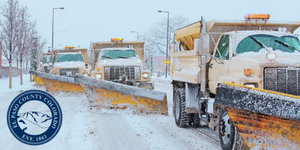
Trucks that are actively plowing can kick up clouds of snow that reduce visibility for motorists in adjacent lanes. They can also create ridges of snow in between lanes that make changing lanes challenging. For these reasons, motorists should never pass snowplows.
Remember to:
- Maintain a SAFE driving distance
- SLOW DOWN when approaching a plow
- Adjust your SPEED for the road conditions
- Plows travel around 35 MPH (often slower than the posted speed limit)
- The SAFEST place to drive is BEHIND a plow where the road is clear and salted